

Key takeaways:
- The conflict in the Middle East has led to a surge in energy prices, with oil prices having been above US$90 a barrel for about a month now and likely to climb further unless the Strait of Hormuz reopens.
- Many observers are expecting that this rise in oil prices and the value of Canada's oil exports will be a positive terms-of-trade shock for the Canadian economy, boosting growth, income, and the Canadian dollar.
- However, as was observed in 2022 following the Russian invasion of Ukraine, it is unlikely to be the case.
- Generally, an improvement in the terms-of-trade from higher export prices is linked to an increase in national income and an appreciation of a country's currency. However, the terms-of-trade theory assumes that these higher revenues flow back into the domestic economy.
- As we have documented in the past, a smaller proportion of these higher revenues is staying in the Canadian economy (see The Canadian dollar: A petro-currency no more). Hence, the impact of the positive terms-of-trade associated with higher oil prices is smaller than in the pre-2015 period.
- More precisely, a greater share of revenues is being returned to shareholders, 75% of whom are not Canadian, and a smaller share of oil revenues is being invested back into operations. Hence, a reduced share of revenues is being spent in the domestic economy and converted into Canadian dollars.
- As a result, the link between oil prices and the Canadian dollar has collapsed in recent years, with the correlation between the two being essentially zero, and the coefficient on energy prices being no longer significant in the post-2017 period.
- The smaller share of oil revenues returning to Canada means that the improvement in the terms-of-trade, due to higher oil prices, will have less of a positive impact on national income and growth.
- Hence, the tailwind on the economy from the increase in oil prices will be weaker, providing less offset to the negative impact on the economy from the decline in household purchasing power and increased business costs.
- The current high oil prices are unlikely to lead to a surge in investment by the oil and gas industry. While the high prices may look attractive, they are driven by short-term supply disruptions rather than a sustained increase in demand, which means they could normalize rapidly. Moreover, investments in the sector take years to be operational, too late to solve the current supply issues.
- In the medium term, a 10-year horizon, we are likely to see a rise in investment in the sector, as net energy-importing countries will seek to diversify their suppliers, with Canada likely to benefit from this.
- In the longer term (20 years or more), the impact of a second oil shock in less than 5 years could be significant. For many countries, like China, India, Europe and most of Asia, reducing their reliance on imported energy is becoming an economic and strategic imperative, not an environmental one. This could accelerate the transition away from fossil fuels, leading to a faster decline in long-term demand for fossil fuels.
- Moreover, higher energy prices will have a greater impact on inflation due to the absence of currency appreciation, which previously helped mitigate some of the increase in oil prices.
- This could have implications for monetary policy, as a negative supply shock due to higher oil prices could be more inflationary than in previous periods.
An increase in oil prices has generally been viewed as positive for the Canadian economy because of the improvement in the terms of trade it entails. As such, increased export revenues are usually a positive tailwind for the economy, leading to stronger growth, higher incomes, and currency appreciation.
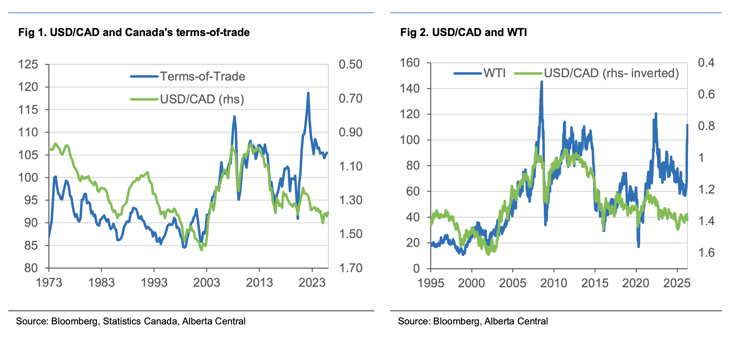
However, as we have documented in the past (see CAD no longer a petrocurrency), the relationship between the Canadian dollar and oil prices has weakened in recent years and increases in oil prices now have a smaller impact on the Canadian economy.
In light of the recent surge in oil prices due to the conflict with Iran, we thought it would be a good time to re-explore the diminished relationship between oil prices and Canada's terms of trade.
The terms-of trade and the Canadian dollar: a broken relation
The terms-of-trade is the relative level of export prices and import prices. When export prices rise faster than import prices, the terms of trade improve. This means that, all else equal, exporters' revenues increase faster than importers' costs, leading to higher national income. Consequently, there should be an increase in net inflows into the country. As more foreign currency is converted into local currency, this leads to an appreciation of the local currency.
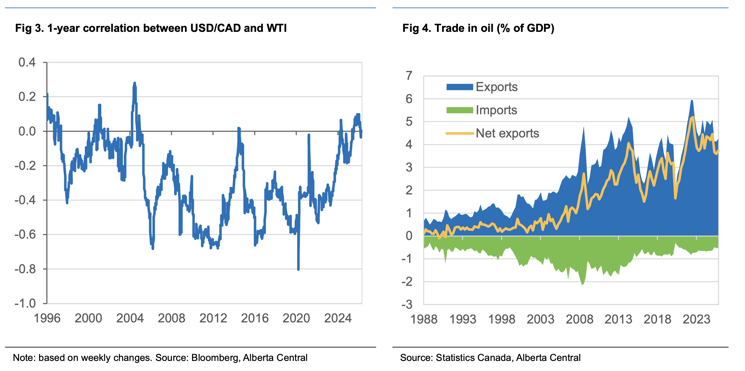
Canada is a prominent exporter of natural resources, with commodity exports accounting for about 45% of total Canadian exports of goods and services, or a little more than 15% of GDP. This means that commodity prices heavily influence its terms-of-trade and the value of its currency. Similarly, oil has become an increasingly important commodity export in recent decades, with oil exports representing almost 5% of GDP (almost 4% if looking at net exports) compared to less than 1% of GDP pre-2000s.
Hence, oil prices play an important role in the evolution of Canada's terms-of-trade and on the Canadian dollar; this has been documented by the BoC (see The Turning Black Tide: Energy Prices and the Canadian Dollar). Moreover, financial market participants tend to focus on oil prices (mainly WTI) as a proxy for changes in the Canadian terms-of-trade and the exchange rate between the Canadian dollar and the US dollar, USD/CAD.1
However, as we have documented before, there has been a break in the relationship between the Canadian dollar and oil prices (see chart above). Historically, both moved closely together. However, in 2022, while oil prices rose sharply following Russia's invasion of Ukraine, the CAD did not appreciate to a similar extent. In addition, the gap between oil prices and USD/CAD has been persistent and has narrowed only as oil prices have normalized.
As such, we note that the correlation between USD/CAD and the Western Texas Intermediate (WTI) has diminished substantially over the period. While the 1-year correlation between weekly changes in WTI and USD/CAD has averaged about 0.4 since 2005, it has declined since 2022, now close to 0. This means that, over the past year, an increase in oil prices has not been associated with an appreciation in the Canadian dollar.
Pushing the analysis further using econometric modelling, we find that the break in the relationship between USD/CAD and energy prices that occurred in the mid-2010s remains in place (see The Canadian dollar: A petro-currency no more). As such, when regressing changes in the exchange rate on changes in energy commodity prices, changes in non-energy commodity prices, changes in the interest rate differential and the lagged independent variable, we find that from 1997 to 2014, the coefficient associated with energy commodity prices is significant and of anticipated sign, i.e., higher energy prices lead to an appreciation in the Canadian dollar. However, since 2017, the coefficient has become non-significant, suggesting that changes in energy prices are no longer a determinant of the changes in the Canadian dollar exchange rate.
Interestingly, our regression analysis shows that the importance of other factors influencing the Canadian dollar exchange rate (such as non-energy commodity prices, interest rate differential, and risk appetite) has not changed, even as the influence of energy prices has disappeared.
Why are high oil prices having a smaller impact on the Canadian economy
While compelling and intuitive, the terms-of-trade theory rests on an important assumption: that increased net export revenues flow into the domestic economy, boosting national income and domestic demand, and increasing demand for the local currency as the revenues are converted into it.
However, if the increased revenues are not converted from US dollars to Canadian dollars, there is no increase in demand for CAD and no appreciation of the currency. The actual size of this transaction will determine the change in the exchange rate, not the evolution of export and import prices. Similarly, if the increased revenues are not spent in the local economy, the impact will also be muted.
Such episodes have happened in the past. In February 2012, noting that the relationship between the Canadian dollar and WTI oil prices seemed to have broken down, we identified the widening spread between the Western Canada Select (WCS) and the WTI as a potential culprit.2 The reason for the reduced link between USD/CAD and WTI is that the actual value of Canadian oil exports was smaller than estimated using only WTI, due to the discounted price Canadian oil producers receive, which is based on WCS. As a result, the potential flow into the Canadian dollar was about $2bn lower per month, according to our estimates, leading to less appreciation of the Canadian dollar.
A similar situation has been occurring in recent years. However, the magnitude of the flow affected is significantly greater than in 2012, leading to a much greater impact on the relationship between CAD and oil prices.
With record oil export volumes and high prices, the value of Canadian oil exports has remained elevated in recent years, between $140bn and $160bn; $143bn in 2025. As a result, oil producers' revenues are also elevated.
However, as we have documented in recent years (see The Lost Decade(s): or how the oil boom masked Canada's economic mediocrity for a recent discussion), a smaller share of these revenues is returning to the Canadian and Alberta economies. Hence, the impact of the positive terms-of-trade associated with higher oil prices has been smaller in recent years.
There are two reasons for this situation:3
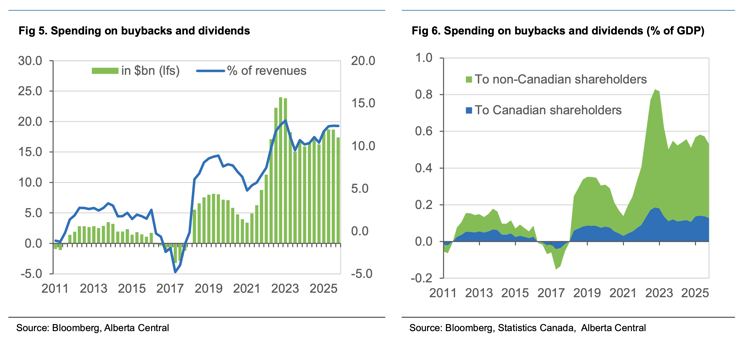
1) A greater share of revenues is being returned to shareholders.
We estimate that about 12% of revenue (about $18bn a year over the past three years) is returned to shareholders through share buybacks and dividends. In comparison, that proportion was about 2.5% of revenues ($2.5bn) in 2014. Moreover, it is estimated that about 75% of these shareholders are non-Canadian, compared to 62% in 2014. This means that most of the flows back to shareholders are not an inflow into Canada. Adjusting for foreign ownership, we estimate that the payment to foreign shareholders is currently equivalent to almost $14bn, or 0.4% of GDP, compared to about $1.4bn, or less than 0.1% of GDP, in 2014; more than four times as large a share of GDP.
2) A smaller share of revenues is invested back into operations.
Most oil producers' cash is likely held in USD. This is because oil is traded in USD, so most of their revenue is in this currency. In addition, we note that, as about 75% of their financial market debt is denominated in USD, USD cash is required for debt service payments. As such, only the revenues converted to CAD to cover Canadian expenses will affect the exchange rate. These expenses include operational costs in Canada, investments in Canadian operations, and royalty payments.
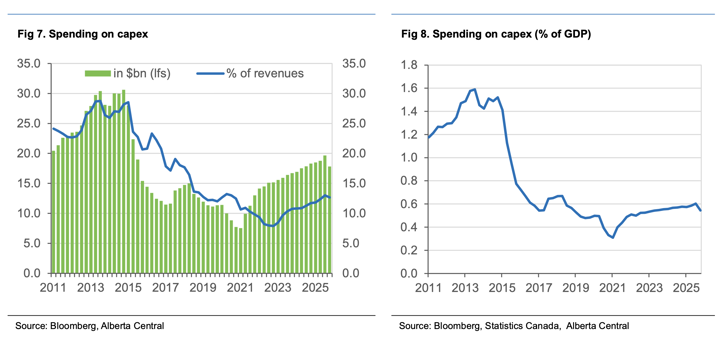
As we have documented, oil producers are reinvesting a much smaller share of their revenues into their operations, most of which are in Canada. We estimate that they reinvested about 12% of their revenues (about $19bn) over the past year. This compares to almost 30% of revenues in 2014 (about $30bn). Putting these flows into perspective, the estimated repatriation flow was almost $30bn, equivalent to 1.5% of GDP, in 2014, while it is now about $12bn, or 0.6% of GDP. This means the purchase of CAD for reinvestment is less than half of what it used to be.
3) High oil prices will not spur investment, at least in the short term.
When it comes to investment in their operations, an important question is whether current high oil prices incentivize oil producers to increase capital spending.
Given the current high prices, many would expect to see increased investment in the Canadian oil and gas sector. However, based on the experience from 2022-2023, it seems unlikely we will see a wave of new investment. It is important to understand why Canadian oil companies did not significantly increase capex investment when oil prices spiked following the invasion of Ukraine.
Investment in the sector in Canada requires a significant upfront capital commitment to build the pipelines and production facilities needed to increase Canada's supply. Hence, some certainty regarding the return on investment is required.
The first consideration will be whether the current high prices can be sustained. Given that higher prices are due to a drop in supply, rather than an increase in demand, there are legitimate concerns that oil prices could normalize as soon as supply returns to the market. Destruction of some production and shipping facilities in the Middle East or Iran, imposing a toll on ships crossing the Strait of Hormuz or a risk premium on oil, could lead to more persistent high oil prices. But in most of these scenarios, oil prices are likely to decline.
A second consideration is that these investments take significant time to become operational, calculated in years, not months. This means that any investment now to increase supply is likely to come online after the supply disruption has been corrected.
Hence, the investment sector will not boom, and we will not see investment levels as high as in the early 2010s, when increased demand was a significant driver of higher crude prices. Nevertheless, we should still expect the industry to try to increase production in response. But higher production and shipping volumes will come from improving efficiency in their current operations and increasing their utilization rate. As a result, while the sector will be somewhat positive, it will be limited.
However, the current situation, the second energy supply shock in less than five years, could lead to more investment in the medium term (5 to 10 years), as countries that are net importers of oil will want to diversify and secure new supplies. This will likely support investment in Canada's energy sector.
The real question may be what happens to oil demand in the longer term, 20-plus years. With a second significant oil shock in less than 5 years, many countries, including China, India, and other Asian nations, are likely rethinking their dependence on imported energy. Reducing their reliance on net energy imports may become an economic and strategic imperative, not an environmental one. This has the potential to accelerate their transition away from fossil fuels towards locally produced energy, primarily nuclear and renewable sources. This could lead to a faster decline in global demand for fossil fuels in the long run.
Main positive: a royalty revenue windfall.
The surge in oil prices will have a significant positive impact on Alberta's fiscal situation. When the province released its budget for FY2026-27, the deficit was estimated to reach C$9.4bn, based on the assumption that oil prices would average $60.5 per barrel over the fiscal year.
But with oil prices exceeding US$100 per barrel, the situation has completely reversed. We estimate that, if oil prices average US$100 a barrel in FY2026-2027, Alberta could see a fiscal surplus of about $15bn. Even if oil prices were to normalize, the average oil prices for the fiscal year will likely be higher than the US$60.5 assumed in the Budget. However, the province could still post a deficit, as the Budget requires an average price of US$74 to be balanced.
Implications
What is clear from these calculations and observations is that inflows into the Canadian economy and the CAD from higher oil exports have declined significantly as a share of the value of oil exports compared to 2014. As a result, the increase in oil prices is not as positive for the Canadian economy and the Canadian dollar as the terms-of-trade would suggest.
As a result, the positive terms-of-trade effects associated with higher oil prices are much less of a buffer against their negative impacts.
As such, the more muted investment response to higher oil prices means it will offset a smaller share of the drag that higher energy prices will have on the rest of the economy, due to the decline in household purchasing power and higher costs for businesses.
The smaller share of oil revenues returning to Canada means that the improvement in the terms-of-trade is not as beneficial as suggested by export and import prices. As such, higher oil prices will have a smaller positive impact on national income and growth, resulting in less wealth being created in the economy.
Similarly, the lack of appreciation in CAD in response to higher oil prices will have broader implications for the Canadian economy. Higher energy prices will have a greater impact on inflation than before. Since commodities are priced and paid for in USD, when CAD appreciates amid higher oil prices, the cost in Canadian dollars increases but by less, offering some reprieve. However, without this exchange rate appreciation, the rise in commodity prices will fully pass through to inflation.
In general, higher oil prices remain a net benefit to the Canadian economy. However, their impact is less positive than it was a decade ago.
This could have implications for monetary policy, as the impact of a negative supply shock on growth and inflation from rising oil prices could be more severe than in previous periods. This implies that, in general, higher oil prices will be more inflationary and could make the BoC more sensitive to energy prices when setting monetary policy. This is also important, as the second-round effect of higher energy prices on other prices can be significant in the Canadian context (see The current energy shock is more inflationary and stickier than the 1970s oil shocks).
Conclusion
The decline in the relationship between oil prices and the value of the Canadian dollar is a sign that higher oil prices are not leading to the same improvement in the terms-of-trade as in the mid-2010s. This means the Canadian economy is less positively affected by higher energy prices because higher revenues are not fully flowing back into the country. This will lead to less improvement in national income and economic growth, making growth less sensitive to energy prices while being slightly more inflationary.
1 In this report, we use financial market convention of expressing the exchange rate between the Canadian dollar and the US dollar as the number of Canadian dollars equivalent to one US dollar, denoted USD/CAD.
2 See "Exploring the broken link between USD/CAD and oil prices", Nomura Securities, 29 February 2012.
3 Using available financial data from some of the big Canadian oil producers.
Disclaimer
The views and opinions expressed in this publication are solely and independently those of the author and do not necessarily reflect the views and opinions of any organization or person in any way affiliated with the author including, without limitation, any current or past employers of the author. While reasonable effort was taken to ensure the information and analysis in this publication is accurate, it has been prepared solely for general informational purposes. There are no warranties or representations being provided with respect to the accuracy and completeness of the content in this publication. Nothing in this publication should be construed as providing professional advice on the matters discussed. The author does not assume any liability arising from any form of reliance on this publication.