

Key takeaways
- As a result of more than a decade of house prices substantially outperforming income, plus higher interest rates in recent years to fight inflation, housing affordability sits at its lowest in four decades in many Canadian cities.
- It is well documented that housing shortages have been the main cause of rising house prices, and that boosting housing supply will be key to restoring affordability. Far less attention has been paid to the adjustment in house prices, incomes and interest rates that restoring affordability would actually require.
- Based on metrics using more than 40 years of data, affordability in Toronto and Vancouver has never been lower. Montreal, Ottawa and Winnipeg are at levels not seen since 1981. Calgary and Edmonton remain slightly above their historical averages, but are eroding rapidly — especially Calgary.
- Affordability has worsened rapidly since early 2022, when interest rates began to climb. Montreal saw the steepest decline over the period, followed by Vancouver, Ottawa, Winnipeg and Calgary. Thanks to declining house prices, Toronto saw the smallest deterioration.
- The adjustments needed to restore affordability are far larger in cities such as Toronto, Vancouver, Montreal and Ottawa than in cities where affordability has held up better (Calgary, Edmonton and, to a lesser extent, Winnipeg).
- At current incomes and interest rates, house prices would need to fall by 50% in Toronto, 43% in Montreal, 38% in Ottawa and 35% in Vancouver to restore affordability.
- At current house prices and interest rates, income in Toronto would need to more than double. Assuming 4% annual income growth, prices would have to stagnate for almost 18 years. In Vancouver, incomes would need to rise 83%, requiring a little over 15 years of flat prices.
- At current house prices and incomes, interest rates would need to turn negative in Toronto to restore affordability. Mortgage rates in Ottawa and Montreal would need to fall below their lowest points in history.
- With monetary policy in restrictive territory and rate cuts expected, we also model the adjustments required if mortgage rates returned to their average pre-pandemic level.
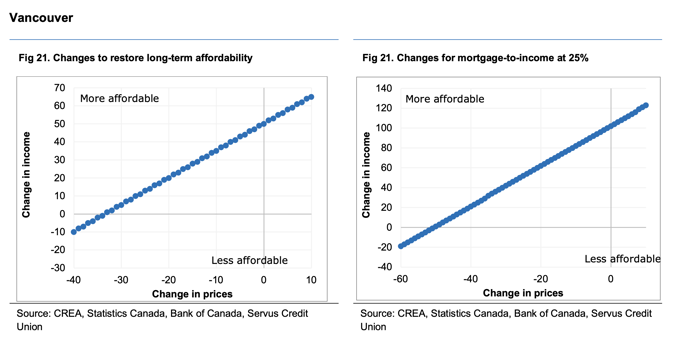
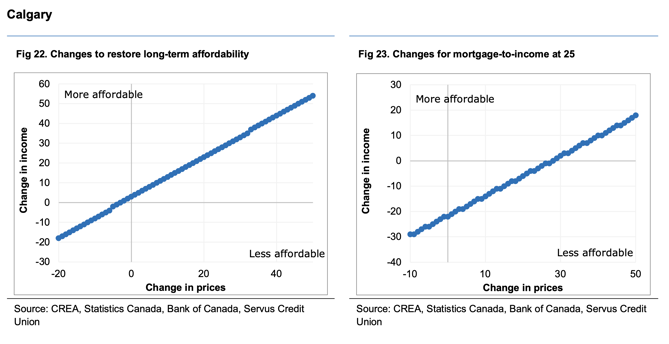
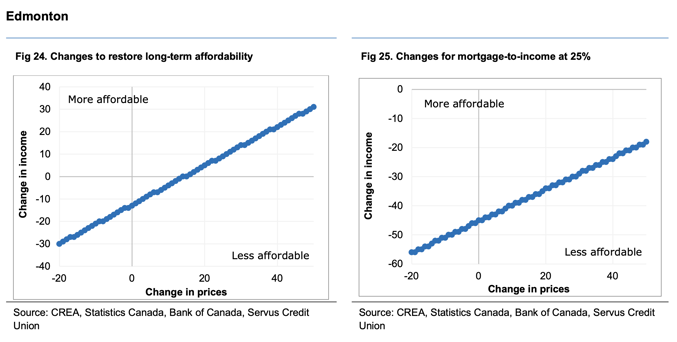
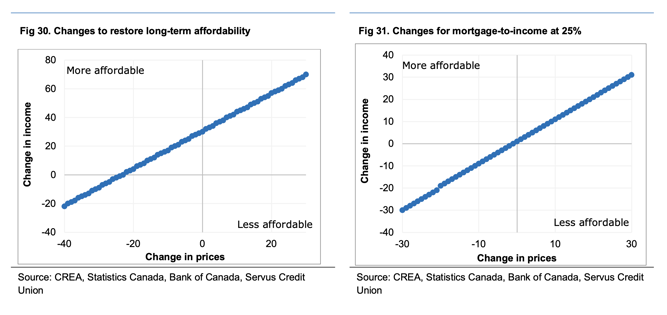
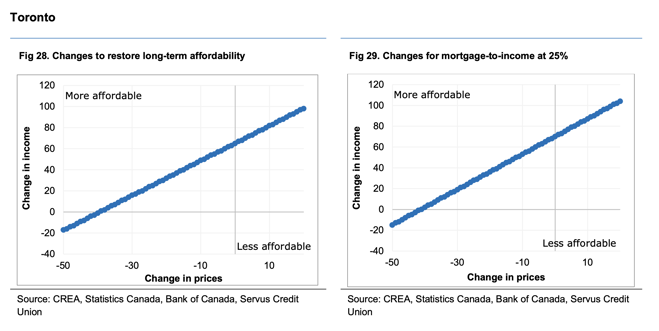
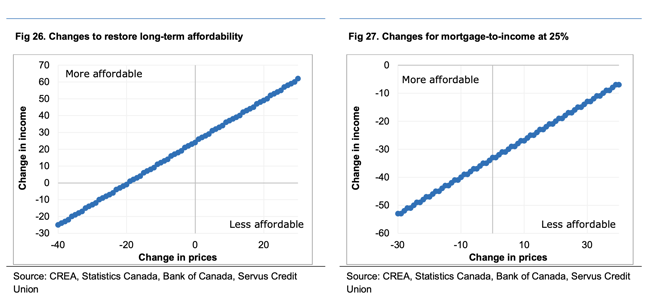
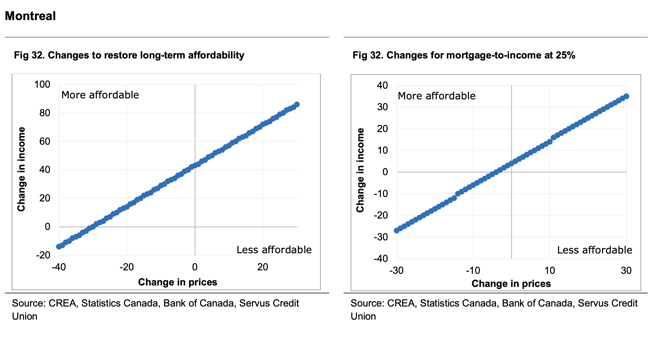
- Even under that scenario, adjustments remain sizeable: prices would need to fall 39% in Toronto, 33% in Vancouver, 30% in Montreal and 23% in Ottawa at current incomes. No price decline would be needed in Calgary, Edmonton or Winnipeg.
- Holding house prices constant, incomes would need to rise 65% in Toronto, 50% in Vancouver, 43% in Montreal and 30% in Ottawa. At 4% annual income growth, that means roughly 13 years of stable prices in Toronto, 10 in Vancouver, 9 in Montreal and almost 7 in Ottawa.
- Restoring affordability will come at a cost to current homeowners, who may see one of their main assets stagnate for a long stretch or decline, with significant financial consequences for some.
- It is unclear whether homeowners understand these costs or are prepared to bear them. If they are not on board, affordability policies could backfire and trigger a homeowner revolt — derailing the push to improve affordability and deepening the divide between those who own and those who do not.
- The house-price underperformance required to restore affordability could discourage homebuilders from adding new supply, meaning fewer units get built than needed and affordability issues take far longer to resolve.
- There is a clear risk that, without prompt action, housing becomes permanently unaffordable in Canada, with significant costs to the rest of the economy.
Housing affordability is now a national crisis. House prices have climbed well above income for over a decade. As we have shown previously, historically low interest rates before the pandemic offset some of the impact of higher prices and prevented a drastic decline in affordability. But the rise in interest rates over the past two years to fight inflation, combined with price pressures from record population growth, has pushed affordability to extreme lows in many Canadian cities. We estimate affordability in many cities is at its lowest since the early 1980s, when interest rates were around 20%. There has been some reprieve recently as house prices declined and lower market rates filtered through to longer-term fixed mortgages, but affordability remains at an extreme low in many cities, carrying real economic costs.
It is well documented that housing shortages have been the main cause of deteriorating affordability, and that increasing supply will be key to fixing it. What goes undiscussed is the impact on house prices needed to bring housing costs back to more normal levels. In this report, we update our valuation and affordability metrics for several Canadian cities and run simulations to estimate how much of a decline in house prices, a decrease in interest rates, and/or a rise in income would be required to restore affordability in each market. These estimates matter because, while policymakers discuss restoring affordability at length, little attention is given to the size of the adjustment required to achieve it.
Valuation metrics
We use the same valuation metrics as in our previous analysis: house price relative to income, house price relative to rent, mortgage payments relative to income, mortgage payments relative to rent, and the income required to afford the average home. We focus on Canada's major metropolitan areas — Vancouver, Calgary, Edmonton, Winnipeg, Toronto, Ottawa and Montreal — covering roughly 50% of the country's population.
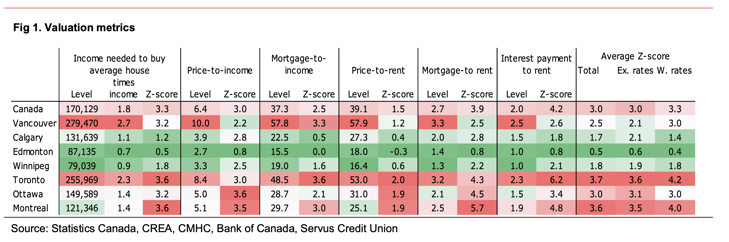
Because there are no clearly defined thresholds, judging whether an asset is overvalued is often subjective, and structural change makes equilibriums hard to pin down. We therefore focus on the gap between the current level of a metric and its "normal" level since 1980, measured as a Z-score (the deviation from the historical mean in standard deviations).
Housing markets are local, so city-specific metrics matter. Vancouver prices, for example, have generally run higher than the rest of the country for four decades. A resident understands and plans around this, and is unlikely to relocate to Winnipeg or Edmonton for cheaper real estate given the cost of commuting. The exception would be a purchase made purely for investment, which would call for investment-focused metrics not included here.
Key valuation findings
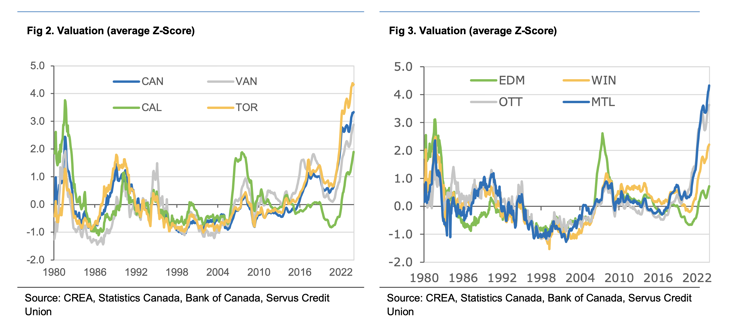
- The Canadian housing market has grown more overvalued in recent years, with an average Z-score of 3.3 across all valuation metrics. That is well above the February 2022 reading of 2.4 (before the Bank of Canada began hiking) and the 1.0 reading in January 2020 on the eve of the pandemic. It is close to the highest level on record and above the 2.4 reached in the early 1980s.
- As much as low rates supported affordability over the past decade, the normalization of rates since 2022 has been the main driver of deteriorating affordability, with a smaller contribution from higher prices.
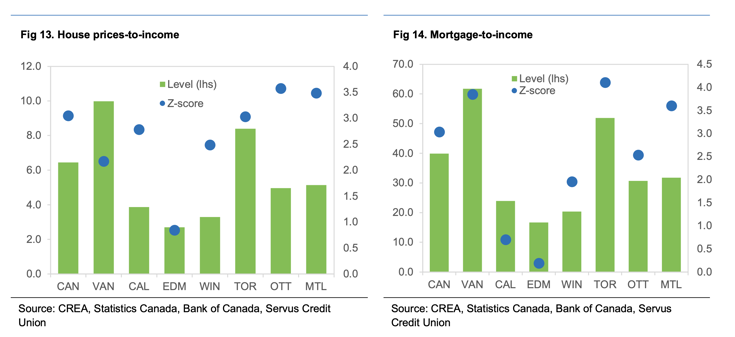
- Many cities — including Vancouver, Toronto, Ottawa and Montreal — have reached record valuation levels recently. With Z-scores of 4.1 in Toronto, 4.1 in Montreal, 3.4 in Ottawa and 2.9 in Vancouver, these markets have never been this overvalued. For context, a Z-score of 4.3 implies a statistical deviation that would occur, on a monthly basis, once every 10,000 months (roughly every 833 years).
- Other cities have also seen sizeable deterioration. Winnipeg sits only marginally below its record score of 2.2, while Calgary and Edmonton remain well below their peaks but above their long-term averages of 1.9 and 0.7, respectively — up from 0.1 and 0.1 before the hiking cycle.
- Declining prices in several cities are easing overvaluation on select measures, notably price-to-income. The easing has been more pronounced in markets identified as overvalued, such as Toronto, Ottawa and Vancouver — though all remain well into overvalued territory, with Z-scores above 3.
- Since early 2022, valuation has deteriorated most in Montreal and Calgary, by 1.5 and 1.3 points respectively. Beyond higher rates, both cities saw a sizeable rise in house prices over the period.
- Even with rates well below their long-term average, valuation metrics that include interest rates generally exceed those that exclude them — 3.9 versus 3.3 nationally — reflecting house prices that are much higher than average, especially relative to income.
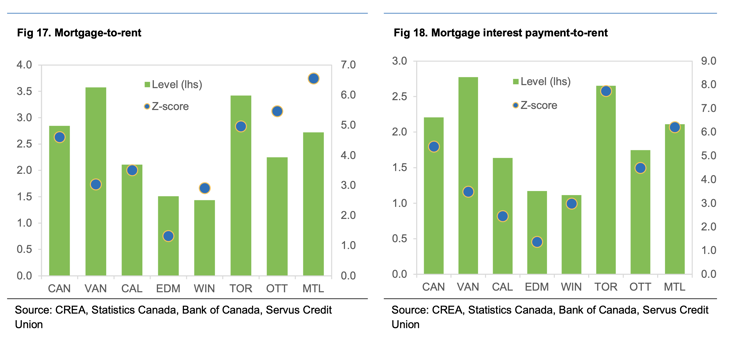
- Most valuations have moved further into overvalued territory since February 2022. The exception is price-to-rent, as house prices fell while rents kept climbing strongly in many markets. Even so, the overvaluation of house prices relative to renting remains elevated.
Affordability measures
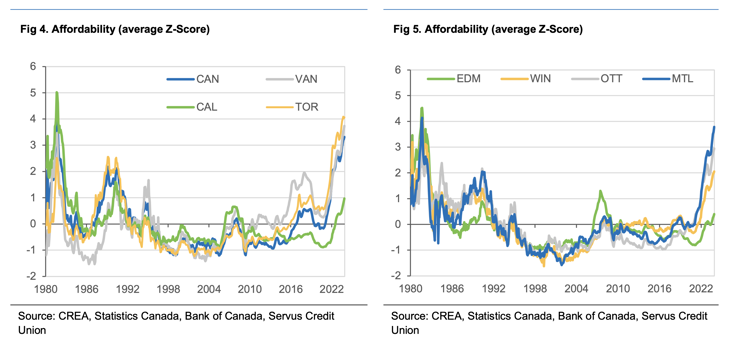
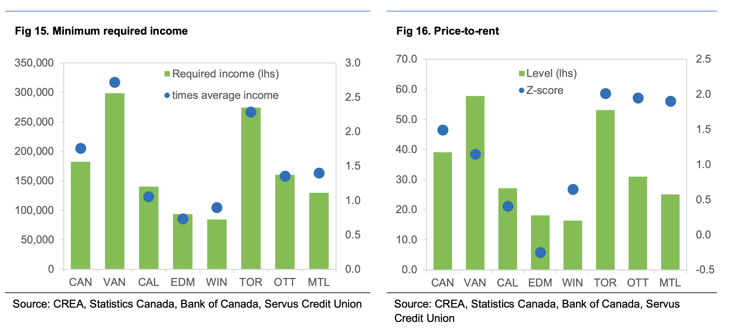
Since house prices peaked nationally in early 2022, there has been a tug-of-war on affordability between higher interest rates and lower prices in some markets. Higher rates have been far more powerful so far, reducing affordability significantly. The combined effect shows up in the required-income measure — both in dollar terms and relative to average income — and in the average mortgage payment relative to income.
On these combined measures, affordability has deteriorated in every city, and more sharply where house prices were found to be overvalued. Specifically:
- Affordability is lowest in overvalued cities, which is no surprise.
- Toronto and Vancouver have never been less affordable, with Z-scores of 4.1 and 3.6 respectively — based on more than 40 years of data that includes the early 1980s, when rates were around 20%. Montreal, Ottawa and Winnipeg are at their most unaffordable since 1981.
- Calgary and Edmonton sit only slightly above their long-term averages of 1.0 and 0.4. But the rapid deterioration, especially in Calgary, suggests policymakers must stay vigilant to keep these cities from following the others.
- Affordability has declined meaningfully since rate hikes began. The largest declines since February 2022 have been in Montreal (2.3 Z-score), followed by Vancouver (2.0), Ottawa (1.5), Winnipeg (1.4) and Calgary (1.4).
- Despite very high prices, Toronto saw the smallest deterioration over the period (1.2 Z-score), the result of an approximately 15% decline in benchmark prices that offset some of the impact of higher rates.
Restoring affordability will require big sacrifices
Rising rates and persistently high prices have driven a significant deterioration in affordability across all major Canadian cities. Price adjustments in a few markets since rates began rising have been too small to move the needle on affordability.
With affordability at or near its lowest point in most cities, the question is: what would it take to restore it? This is an important question that policymakers, homeowners and the public do not seem to grasp — and it is not easy to answer, since it depends heavily on what one believes the equilibrium level of affordability should be.
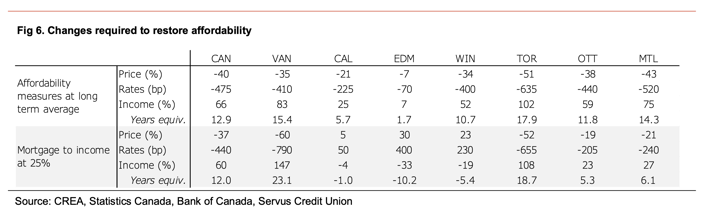
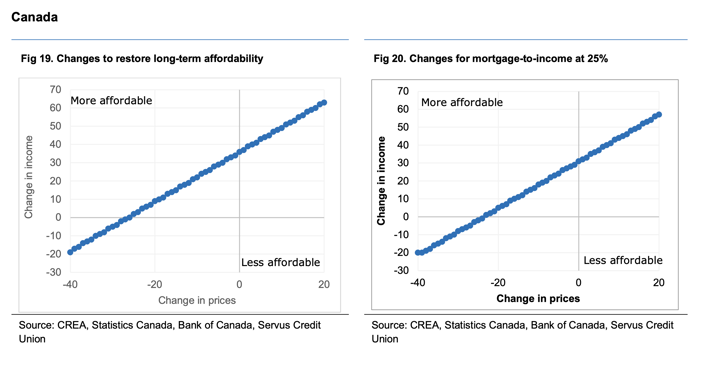
There are three ways to restore affordability: a fall in house prices, a decline in interest rates, and/or a rise in incomes. We estimate how much each factor would need to change to return affordability to "normal," holding the others constant at current levels.
The "normal" affordability benchmarks we consider are:
- The average level of affordability since 1980, based on a blend of mortgage-to-income and the minimum family income required to buy a house relative to average regional income.
- A mortgage-to-income ratio of 25%. Financial institutions typically require total housing costs (mortgage, property taxes, insurance, condo fees and heating) to be below 30% of income to qualify for a mortgage; CMHC uses a similar test. A 25% mortgage-payment-to-income leaves 5% of income for other housing-related expenses.
Unsurprisingly, the least affordable cities — Toronto, Vancouver, Montreal and Ottawa — require far larger adjustments than cities where affordability has held up (Calgary, Edmonton and, to a lesser extent, Winnipeg). What is striking is just how large the adjustments in prices, rates and incomes need to be across most markets.
The change in prices required to restore affordability
At the national level, house prices would need to fall by 40% to restore affordability to its long-term average, at current rates and incomes. The dispersion between cities is wide. At one end, Toronto would need a 51% decline, Vancouver 46%, Montreal 43%, Ottawa 38% and Winnipeg 34%. At the other, prices would need to ease only a modest 7% in Edmonton and 20% in Calgary.
To bring mortgage payments to 25% of average income, national prices would need to fall 37%. Again the spread is large: prices would need to drop 60% in Vancouver and 52% in Toronto, while Calgary, Edmonton and Winnipeg could actually rise by 5%, 30% and 23% respectively.
Change in interest rates required to restore affordability
Nationally, interest rates would need to fall by 475bp to restore affordability to its long-term average. With the average rate on new mortgages around 6.00% at the time of these estimates, that implies a mortgage rate of 1.25% — roughly 75bp below the lowest level reached during the pandemic. In Toronto, rates would need to drop 635bp, meaning a negative mortgage rate to be affordable. At the other end, rates would only need to ease 70bp in Edmonton and 225bp in Calgary.
To hit mortgage payments of 25% of income, rates would need to fall 440bp nationally. Vancouver would require a 790bp decline and Toronto 655bp — negative rates in both cases. In Edmonton, by contrast, rates would need to rise 480bp to push the payment on the benchmark house to 25% of average income. Rates would also need to increase in Calgary (+50bp) and Winnipeg (+230bp).
The change in income required to restore affordability
To restore affordability to its long-term average, average family income would need to rise 66% nationally. At 4% annual growth — with prices and rates held constant — that adjustment would take about 10.4 years. As a reference, disposable income per household grew an average of 3.1% between 2000 and 2019, so 4% may be optimistic, especially with GDP per capita currently declining in Canada. Toronto would need a 102% jump (17.9 years) and Vancouver 83% (15.4 years). Edmonton would need only 7% (1.7 years) and Calgary 25% (5.7 years).
For mortgage payments to reach 25% of average income, national income would need to rise 60%, or prices would need to stay flat for 9.6 years at 4% income growth. Vancouver would require a 147% increase (23.1 years) and Toronto 108% (18.7 years). At the other extreme, income in Calgary would need to fall 4%, Edmonton 33% and Winnipeg 19%.
How much would a normalization in interest rates help?
The estimates above implicitly assume the variables are roughly at "normal" levels, and that interest rates could be used as a tool to restore affordability. But the Bank of Canada's mandate is price stability under its inflation-targeting framework, not housing affordability. As Governor Macklem put it, monetary policy cannot solve the structural issues behind the lack of housing supply.
That said, with policy currently in restrictive territory, the current level of rates is arguably above its equilibrium, and markets expect the Bank of Canada to cut over the next two years. The question is what the equilibrium, or neutral, rate is. The Bank defines the neutral rate as the policy rate consistent with output at potential and inflation at target once cyclical shocks have dissipated — meaning policy is accommodative below it and restrictive above it.
The Bank estimates the neutral policy rate at 2% to 3%. We would argue that strong population growth and a potentially higher global neutral rate point to something higher in Canada — likely 3% to 3.5%. But what matters for housing is the associated mortgage rate, for which we lack a clean estimate.
For simplicity, we assume the equilibrium mortgage rate is the average that prevailed between 2010 and 2019, about 4%. That implies the current rate is roughly 200bp above this level — close to the policy-rate decline needed to return to the Bank's neutral estimate. This may be an underestimate, since the neutral rate could be higher now than before the pandemic, but it still yields useful observations. Assuming mortgage rates should be 200bp lower, the required changes in prices and incomes shrink, confirming the significant impact of interest rates on affordability, especially in overvalued markets.
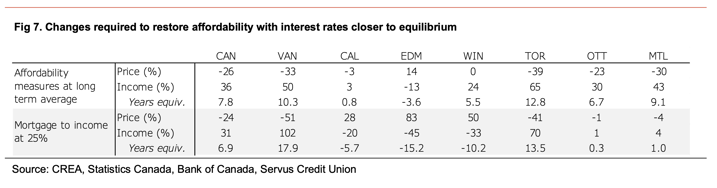
Change in prices required to restore affordability
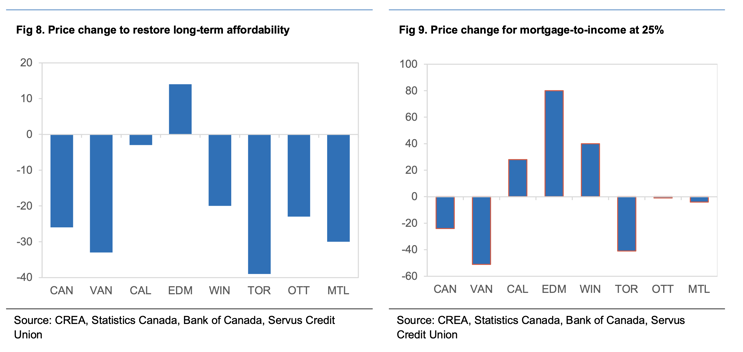
With the lower rate, returning affordability to its long-term average would require prices to fall 26% nationally, 39% in Toronto, 33% in Vancouver, 30% in Montreal, 23% in Ottawa and 20% in Winnipeg. Calgary would need only a modest 3% decrease, while Edmonton has room to rise 14% before reaching its long-term average.
For mortgage payments to reach 25% of income, prices would need to decline 24% nationally, 50% in Vancouver and 41% in Toronto. Barely any change would be needed in Montreal (-4%) or Ottawa (-1%). Calgary, Edmonton and Winnipeg could see prices rise a further 28%, 83% and 50% respectively before payments reach 25% of income.
Change in income required to restore affordability
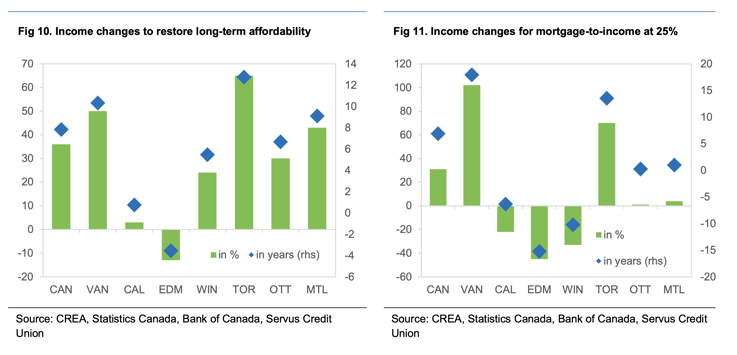
With the lower rate, income would need to rise 36% nationally to restore affordability — about 7.8 years at 4% annual growth. The required increase is 65% in Toronto (12.8 years), 50% in Vancouver (10.3 years), 43% in Montreal (9.1 years), 30% in Ottawa (6.7 years) and 24% in Winnipeg (5.5 years). Edmonton would need no increase — even a decline of less than 13% would keep affordability above average — while Calgary would need a modest 3% rise.
To bring mortgage payments to 25% of income, Vancouver income would need to rise 102% (17.9 years) and Toronto 70% (13.5 years), while Montreal and Ottawa would need only marginal increases of 4% and 1%. Calgary, Edmonton and Winnipeg would need no increase, as their payment-to-income ratios already sit below 25% at current income.
Do homeowners understand the cost of affordability — and are they willing to bear it?
The analysis shows sizeable adjustments would be required in most cities. At best, prices stagnate at current levels for years while income catches up; at worst, they decline meaningfully and rapidly. The most likely outcome lies somewhere in between.
What is clear across every combination of falling prices and rising income is that restoring affordability comes at a cost to current homeowners, who would watch one of their main assets stagnate or decline. More specifically:
- Many households have stretched themselves financially to buy. For many, the home is their only financial asset, with little else in savings or retirement funds. Any underperformance in prices could hit these households hard.
- If the adjustment comes mainly through lower prices, some homeowners risk negative equity — where the home is worth less than the mortgage. This is especially true for those who bought since the pandemic.
- Even pre-pandemic buyers could see big swings in net worth if prices fall substantially, with implications for households who have borrowed against their home equity.
An essential question is whether homeowners understand that solving affordability will cost them, and whether they are on board with a prolonged period of underperformance or sizeable price declines. A Nanos survey last fall found about 70% of Canadians would welcome a decline in house prices (60% in Ontario). But the survey did not separate homeowners from non-owners, nor did it quantify the "decline" — whether a modest adjustment of less than 10% or the kind of drop required to restore affordability.
As essential as the cause is, if homeowners are not ready for the cost, affordability policies could backfire and trigger a homeowner revolt, deepening the divide between owners and non-owners. Bedroom communities and suburbs around major metros carry significant political weight, and voters there are constantly courted by politicians. The required price underperformance could also discourage homebuilders from adding supply, meaning fewer units get built than needed and affordability issues take far longer to resolve.
Conclusion
These estimates show that restoring affordability will not be painless — it will come at a cost, especially for current homeowners. But doing nothing should not be an option either, because a lack of affordability imposes significant costs on the rest of the economy, including:
- households spending a greater share of income on shelter, reducing spending elsewhere;
- rising indebtedness as households overstretch to reach homeownership, leaving them more vulnerable to shocks;
- reduced labour-market flexibility, as workers hesitate to take jobs in more expensive cities;
- widening inequality between homeowners and renters;
- immigrants and Canadians leaving the country due to a lack of affordability and homeownership opportunities; and
- social issues such as homelessness and intergenerational poverty.
Our analysis outlines two paths: a fast correction via a drop in house prices, or a prolonged adjustment lasting over a decade that perpetuates the costs of low affordability for years. Policymakers will likely prefer the slow path to limit the cost to current homeowners, though it is not clear a faster adjustment would not benefit the broader economy — a determination that would require a thorough cost-benefit analysis. One thing is clear: without prompt action, there is a real risk that housing becomes permanently unaffordable in Canada.
Appendix: Z-score
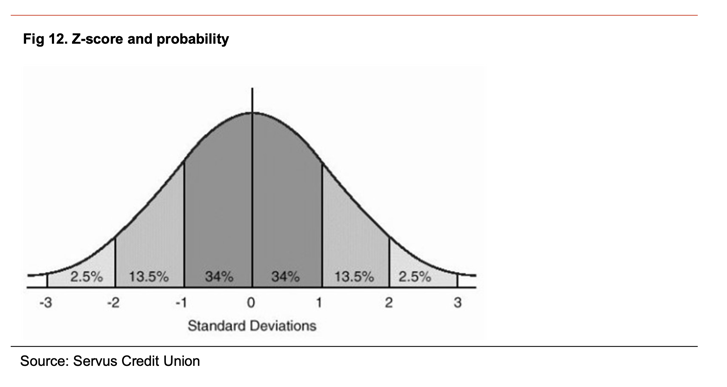
The Z-score measures how far an observation sits from its historical average, in standard deviations. A score of 0 means the observation is on the historical average; a negative score is below it, a positive score above. The Z-score also indicates how likely such an observation is: about 68% of historical observations fall between -1 and +1, and 95% fall between -2 and +2. A score above 2 occurs only about 2.5% of the time — in our analysis, just 12 times between 1980 and 2021 across 495 observations.
Using these properties, we define a metric with a Z-score between 1 and 2 as having a stretched valuation, and a metric above 2 as overvalued. This approach assumes the metric was fairly valued over the sample studied.
Appendix: valuation metrics explained
House price to income
This indicator is simply the average house price divided by average family income in the city. It shows how many years of income would be needed to pay for a house if all income went toward it. With minor manipulation, it also shows how long it would take to accumulate a down payment — dividing by 5 for a 20% down payment, or by 10 for a 10% down payment. (Note that average house prices in Vancouver and Toronto exceed $1 million and no longer qualify for CMHC mortgage insurance.)
Mortgage to income
Price-to-income is useful but incomplete, because it ignores a major trend of the past 40 years: the gradual decline in interest rates to a pandemic-era record low. Lower rates meant smaller payments for the same price — or a more expensive house for the same payment. And when households shop for a home, the size of the monthly payment often matters more than the price itself.
So our second measure is mortgage payment relative to income: the share of income an average family would spend buying a home at the city's average price with a 20% down payment, at current mortgage rates on a 25-year amortization.
Minimum required income
Another lens is the family income needed to buy the average house in each city. Most banks require housing costs (mortgage, property taxes, heating, condo fees and insurance) to be at most 32% of income to approve a loan. On that basis, we assume mortgage payments alone should be at most 25% of average family income at current rates and prices. We also compare the required income to the city's average family income: if required income exceeds the average, the "average" family can no longer afford the "average" house — a clear sign of affordability problems.
Price to rent
The measures above focus on ownership affordability, but households can choose to rent. If ownership costs become disproportionately high relative to renting, some households will rent rather than buy. We consider house price relative to rent, which can be read as the number of years a household would rent to spend the same amount as owning. The comparison is imperfect: it does not capture the maintenance costs of ownership (a major recent source of inflation) or mortgage payments, nor the fact that a home is an asset on the household balance sheet.
Mortgage to rent
When weighing buying versus renting, households compare what they would spend each month. Using the same mortgage payment as above, we look at the payment relative to rent. Like the previous measure, it excludes ownership costs such as repairs, maintenance and property taxes. It also captures the record-low level of rates and shows how large the average mortgage payment is relative to average rent.
Mortgage interest payment to rent
A mortgage payment is not fully comparable to rent. The portion that covers principal repayment can be viewed as forced savings that builds net worth, so it can make sense for a household to stretch its payment relative to rent, especially when rates are low. With that in mind, we also consider the size of the first mortgage interest payment relative to rent.
Appendix: Affordability frontiers with interest rates at equilibrium
Disclaimer
The views and opinions expressed in this publication are solely and independently those of the author and do not necessarily reflect the views and opinions of any organization or person in any way affiliated with the author, including, without limitation, any current or past employers of the author. While reasonable effort was taken to ensure the information and analysis in this publication is accurate, it has been prepared solely for general informational purposes. There are no warranties or representations being provided with respect to the accuracy and completeness of the content in this publication. Nothing in this publication should be construed as providing professional advice on the matters discussed. The author does not assume any liability arising from any form of reliance on this publication.