

Key takeaways
- The Bank of Canada started to tighten monetary policy in October. This was more in response to expected increases in broader inflationary pressures than to current conditions.
- Supply shocks are difficult for central banks because monetary policy is the wrong tool to address them.
- Whatever decision is taken, wait or be proactive and hike, the BoC will be blamed if inflation rises or if the economy falters. Since criticism is unlikely to be avoided, it is better to receive it for reaching its policy objective, i.e. keeping inflation within its target.
- This suggests that the BoC is more likely to have a tightening bias going forward.
- While it is clear that the BoC is reacting to expected inflation, it remains important to track whether we are seeing a build-up in inflationary pressure.
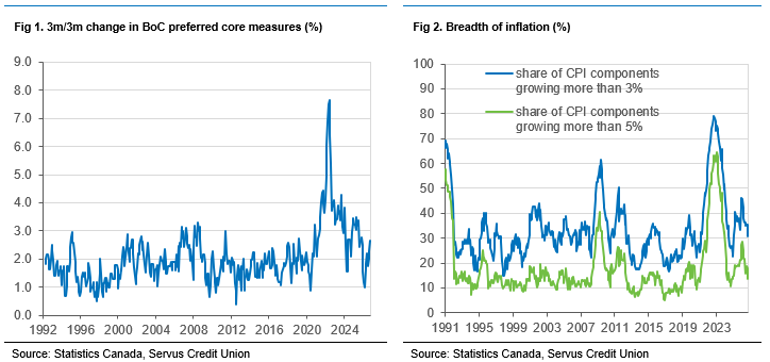
- In the past, we have relied on the share of CPI components rising by more than 3% and 5% to measure the breadth of inflationary pressures and the 3m/3m annualized change in components of CPI to measure the momentum in price pressures.
- In this report, we create the Inflation Momentum Index, which blends both approaches by using a diffusion index of the forecasting error on each individual component of CPI.
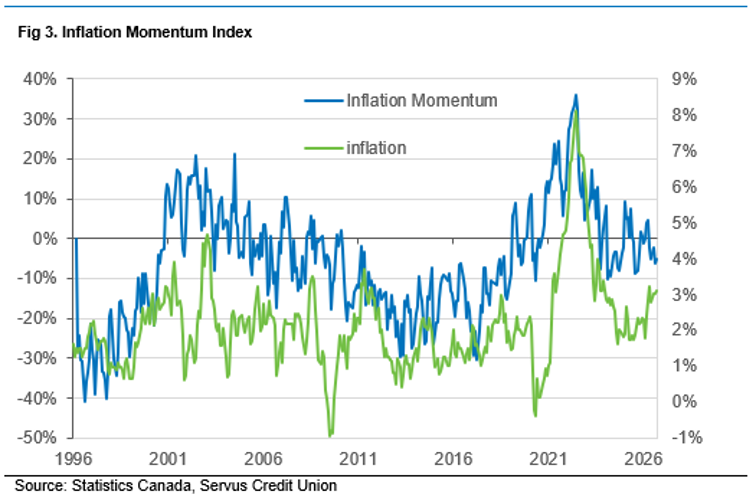
- The Inflation Momentum Index indicates that inflationary pressures are not broadly on the rise, suggesting that underlying inflationary pressures remain contained.
- The lack of inflationary pressures now doesn't necessarily mean that the BoC is making a mistake by tightening monetary policy. It is taking a forward-looking perspective on inflation, and what matters, in its view, is not whether we will see greater and broader inflationary pressures, but when we will experience them.
Since the beginning of the year, many shocks have increased global inflationary pressures, including the war in Iran, Ukrainian attacks on Russian refineries, and US tariffs. The impact has been significantly higher energy, transportation and input costs for businesses, which are being passed on to consumers to some degree.
Many central banks have tightened their monetary policy since the beginning of the year in response to the inflationary risk, and the Bank of Canada did so at its October policy meeting. The BoC made it relatively clear that it wants to get ahead of the curve and start reducing monetary accommodation early rather than later, despite little to no evidence of broad inflationary pressures.
In this report, we introduced a new measure of underlying inflationary pressures to help us monitor the situation.
Why did the BoC decide to increase its policy rate?
The main reason for the BoC to hike was that, in its view, it is only a matter of time before high input costs for businesses get passed through to consumers. As such, the "Governing Council decided to increase the policy rate to reduce the risk that continuing high energy prices spread broadly to the prices of other goods and services."
Supply shocks are the most difficult economic shocks for central banks because monetary policy is the wrong tool to address them. As a result, whichever decision they make, they will face criticism.
- If they do not tighten monetary policy, they will be blamed for having left inflation rise beyond their target, similar to what happened in 2022-2023.
- If they tighten monetary policy, they will be blamed for having stifled economic activity and the job losses that could result from the weakness.
Given that the BoC's mandate is price stability, as defined by the inflation target, the central bank is prioritizing inflation control, with the economic consequences as an afterthought. As such, removing the reference to employment as an objective from the renewed BoC mandate reinforces that the central bank is more likely to choose pre-emptive tightening over its potential negative consequences for economic activity.
After all, if criticism cannot be avoided, the BoC will prefer to receive it for reaching its policy objective or, in other words, for doing its job.
Looking ahead, this means the BoC may be biased toward policy tightening when the economy is affected by supply shocks. In addition, the fact that PRIMA, the BoC's newest model for the economy and inflation, is based solely on headline inflation, suggests that the BoC's focus on core inflation may have diminished.
Is future inflation building up?
The source of inflationary pressures in Canada is mostly due to global factors. High oil prices and record diesel prices are pushing up transportation costs. Everything that is consumed in Canada must be transported over vast distances, whether it is fresh produce from Mexico, consumer goods from China, etc., meaning that rising transportation costs end up being passed to consumers at some point.
So far, transportation costs have not risen as much as diesel prices suggest. Similarly, when diesel prices eased in 2024-2025 and at the beginning of the year, transportation costs did not and remained mostly unchanged at their elevated 2022-2023 level. One could wonder whether this means transportation companies have more buffer in their profit margins to absorb, or delay for longer, the increase in input costs to consumers.
Inflation expectations have also increased in the BoC's most recent Business Outlook Survey and the Canadian Survey of Consumer Expectations. The concern is that higher inflation expectations could make inflation stickier and more persistent.
What does inflation today tell us?
The most recent CPI release showed headline inflation at 3.1% in September, slightly above the BoC's upper range of its inflation target, and around 3% for the past three months. However, most of the increase in inflation since the beginning of the year is mostly due to higher gasoline prices, with inflation excluding gasoline hovering between 2 and 2.4% since the beginning of the year. Similarly, while inflation excluding food and energy has been trending higher since the beginning of the year, from 1.5% in April to 2.1% currently, it remains contained.
The Bank of Canada's preferred measures of core inflation also do not suggest rising inflation pressures, averaging 1.85% in September. Both CPI-trim and CPI-Median have been easing, having started the year around 2.5%.
The problem with measures of core inflation that exclude components is that deciding which components to exclude can be subjective. In other words, one can always remove the components they don't like and obtain a core measure of inflation that fits their view. Hence, systematic measures of core inflation, like CPI-Trim and CPI-Median, are useful because they are less influenced by judgement. Nevertheless, they are missing two important dimensions of inflation: 1) breadth or how broad-based the inflationary pressure is, 2) momentum, whether the inflationary pressures are due to accelerating price increases.
This is the reason we have been focusing for some time on the share of CPI components rising by more than 3% and the share rising by more than 5%. Both measures are at their lowest levels since late 2024, showing that inflation has not broadened since the beginning of the year.
The momentum measure, which looks at the change in prices over the past three months, helps us see whether pressures are building in recent months. By focusing on the most recent three months, this indicator can help determine whether the rise in inflation is due to increased price pressures or simply base effects (inflation is the change in prices relative to the same month the previous year). On that measure, headline inflationary pressures increased in September and were elevated, with the 3-month annualized change in headline CPI at +3.6%. However, the momentum of BoC's core measures was more subdued below 3%.
The main conclusion is that, while headline inflation is elevated, there are no evidence that inflationary pressures are spreading beyond gasoline.
The Inflation Shock Momentum Index
In an effort to better monitor inflationary pressure, we develop a new inflation indicator heavily inspired by the San Francisco Fed Inflation Shock Momentum Index[1]. The idea is to blend the breadth of inflation measures by looking at all the components of the CPI index and the momentum indicators by focusing on the most recent price changes.
The index is constructed as follows:
- For each component in the CPI, a simple autoregressive model of the monthly changes is estimated using a 120-month rolling window. In Canada's case, since the disaggregated CPI data is only non-seasonally adjusted, each component is seasonally adjusted using the ARIMA X13 method before estimating the equation.
- Then, the actual value is compared to the forecasted value from the models, again across all components of CPI.
- At each period, a diffusion index is calculated, counting the proportion of components where the forecast error has been positive for 3 consecutive months, and another counting the share with 3 consecutive negative forecast errors. The diffusion index is then the net share of positive errors.
- The Index is also weighted to ensure that each main section of the CPI has the same importance in the final index, using the weights in the CPI basket. This is because there are far more individual components in the food category than in shelter, which would give it a bigger representation if not weighted.
The intuition behind the index is that if prices increase faster than the simple model would predict for 3 consecutive months, it suggests price pressures are building. More components with increased price pressures indicate a broader build-up of inflationary pressures.
What does the Inflation Momentum Index say?
The Inflation Momentum Index suggests there are no significant, broad inflationary pressures in Canada, with the Momentum Index in negative territory, suggesting that more components are coming in below forecast. This result is very similar to what the breadth indicator and the 3m/3m month annualized change in various measures of inflation would suggest.
Does it mean the BoC made a mistake by increasing its policy rate in October?
Not necessarily. The BoC is taking a forward-looking perspective on inflation. Its view is that it is not a matter of whether we will see greater and broader inflationary pressures, but rather when we will experience them. However, while models are useful, they can also fail on occasion.
The speed and size of the shock matter. The post-pandemic period, exacerbated by the war in Ukraine, saw the biggest and fastest increase in gasoline prices in Canada's history, as measured by the CPI. The increase in gasoline prices in 2021-2022 was both bigger and faster than both oil shocks of the 1970s.
The rise in gasoline prices since the start of the war in Iran in March 2026 has also been faster and bigger than the oil shocks of the 1970s, but very similar to the impact of the Ukrainian war in 2022. The difference being that gasoline prices normalized relatively quickly after 6 months of conflict; something we haven't seen in the current episode.
An important reason the speed and size of the shock matter is the use of log differences when modelling. Models in differences in logs offer the clear advantage of making the model linear and having symmetric elasticities, making models easier to interpret. However, the difference in logs remains a mathematical approximation. The bigger the change, the bigger the error between the actual percentage change and the change in logs, leading to larger estimation and forecasting errors, usually resulting in an underestimation. This is partly what has likely happened in the post-pandemic inflationary period.
Interestingly, the Inflation Momentum Index seems to have identified that period relatively early, turning significantly positive in early 2021 and remaining elevated until June 2022, when inflation peaked. This is likely because it focuses on forecast error rather than the point forecast. It would have warned the BoC that inflationary pressures were broad and becoming problematic.
Looking at the current episode, the Inflation Momentum Index shows that there is, so far, little to no evidence of broad inflationary pressures.
Conclusion
The BoC started to tighten monetary policy in October, as it expects inflationary pressures to increase in the coming months, despite little evidence of such pressures at the moment. While the BoC is likely to continue to tighten, it remains important to better assess inflationary pressures. Hence, the usefulness of our Inflation Momentum that blends both the breadth of inflationary pressures and recent price pressures.
[1] Lansing, Kevin J., and Adam Hale Shapiro. 2026a. "Measuring Inflation Shock Momentum." FRB San Francisco Working Paper 2026-10.
Disclaimer
The views and opinions expressed in this publication are solely and independently those of the author and do not necessarily reflect the views and opinions of any organization or person in any way affiliated with the author including, without limitation, any current or past employers of the author. While reasonable effort was taken to ensure the information and analysis in this publication is accurate, it has been prepared solely for general informational purposes. There are no warranties or representations being provided with respect to the accuracy and completeness of the content in this publication. Nothing in this publication should be construed as providing professional advice on the matters discussed. The author does not assume any liability arising from any form of reliance on this publication.